
Because the Crow Flies
. . . Noisily, Every Season, Every Day . . .

So already, the other morning, while I was lying in bed trying to figure out whether the sun had risen yet, I heard the caw of a not-too-distant crow. “Crows have no season,” I said to myself.
Which really means they have every season. I was thinking less about Ecclesiastes than I was about the imminent change of season—the autumn equinox was just a few days away. Seasons come and go, but, at least in my world, crows seem always to be vociferously, obviously around, especially in the early morning.
Suddenly, I thought that I could begin a poem with the observation I’d verbalized to myself. But what would that poem really be about? I paused after that thought: why couldn’t it just be about crows as crows, not crows as metaphors or symbols or representatives of anything else? There was something comforting in the observable consistency and reliability of crows. Wasn’t that enough?
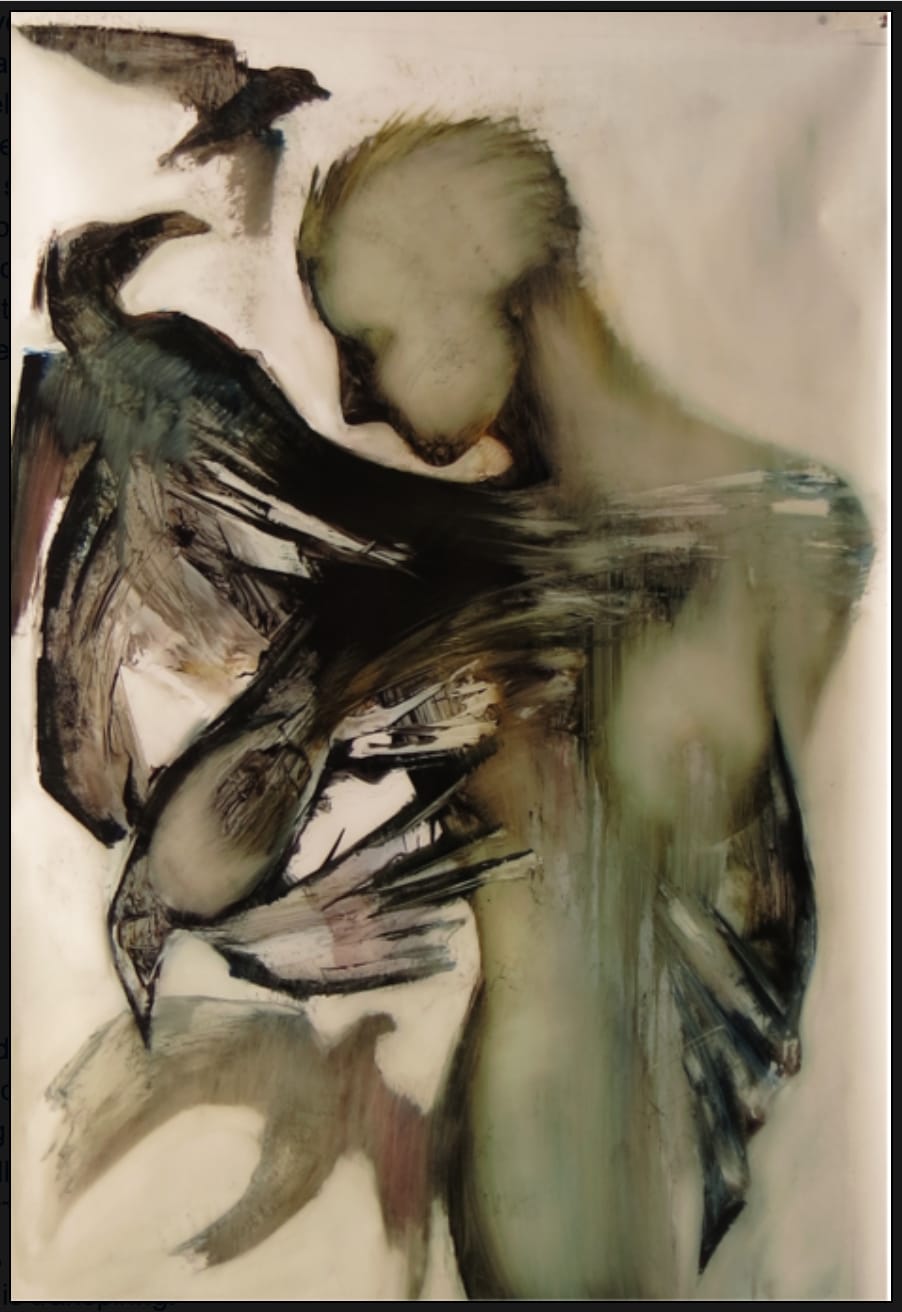
With that thought in mind, I decided to check my crow facts. After offering some guidance for how to distinguish crows from ravens, which also abound where I live, my research confirmed that crows often remain all year long in coastal and urban areas—like the one in which I live—because those areas stay warm enough to make it possible for them to feed all year long.
Good information—but it didn’t give me any ideas for a crow poem. So I decided to check out crow poems written by other people.
Most of them connected crows and hopefulness, I was glad to see. Take for example, Robert Frost’s “Dust of Snow,” as seen in the poster* below—and which I hadn’t read for ages.
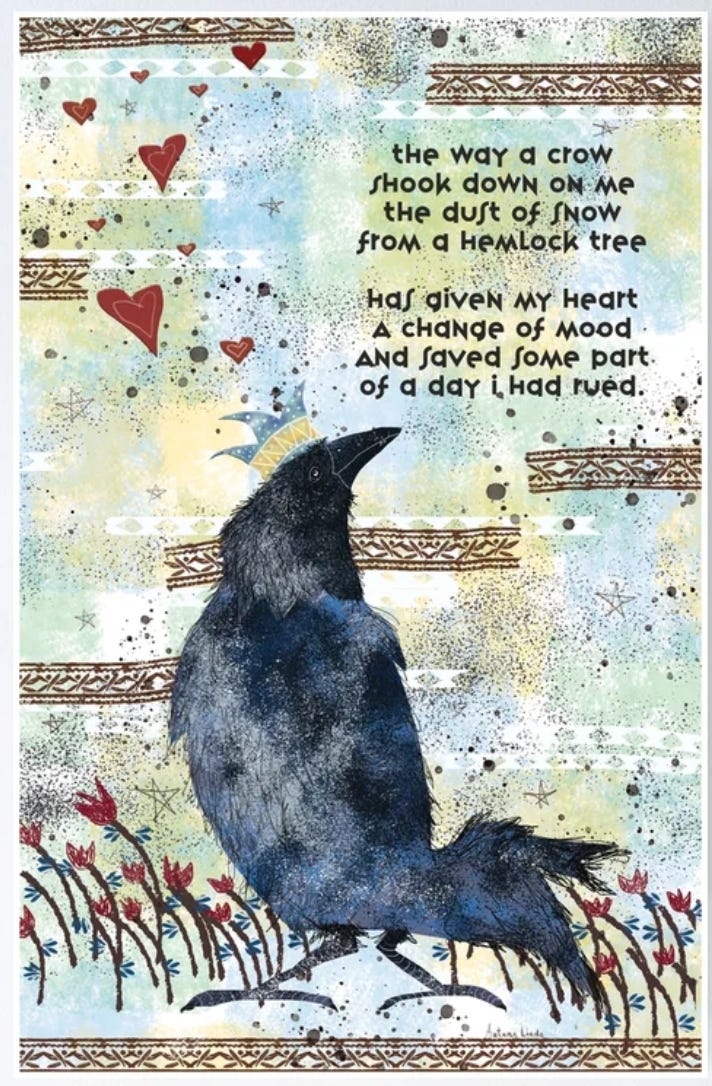
Frost’s poem offered me the companionship of both the poet who was ruing a day and the crow that changed his outlook. Let’s face it: crows may not be adorable, but they often do seem to have good timing.
While some of the crow poems I found referred to crows as harbingers of spring and a number of them contrasted the black of crows with the white of the snow surrounding them, I especially appreciated those that referred to the nearness of crows to people. Take, for example, this passage from John Clare’s sonnet “The Crow,” featured in a blog post sharing several crow poems:
How peaceable it seems for lonely men
To see a crow fly in the thin blue sky
Over the woods and fields, o’er level fen.
It speaks of villages, or cottages nigh
Behind the neighbouring woods – when March winds high
Tear off the branches of the huge old oak.**
In this poem, the sight of the crow’s flight is a balm connecting “lonely men” to other people; it reminds of what is concealed or simply out of view. Beyond the wildness of nature, the crow’s flight reminds us, lie homes, places of comfort and refuge. And it’s the flight itself that “speaks of villages, or cottages nigh.” Flight as speech is an interesting idea. And flight, literally, is uplifting.
And then there’s the mesmerizing nerviness of crows, especially quasi-personified ones who don’t expect to win any beauty or singing contests, and whose intense, in-your-face presence connects them in some people’s minds to wisdom and mythological traditions. This passage from Kelsey Thornton’s “The Crow,” also published in the aforementioned blog post, acknowledges these associations to the ancient while reveling in the crow’s energetic display of “attitude.”
Raucous, unruly, polished, fireback black, . . .
He dances like some Dionysiac,
Swarthy, dapper, bright-eyed, immaculate,
Like coal carved fresh from a mysterious mine,
He struts the field, dress-suited, a malign
Diplomat from an ancient consulate.**
Speaking for myself, I tend to focus on crows in the here and now doing their daily alert, raucous thing, and to overlook the diverse richness of crow traditions, literary and not. Still, my many years of teaching Greek mythology makes it impossible for me to ignore the fact that Dionysian frenzy can tear things—people and animals included—to shreds. Crows are, after all, predators and scavengers, no matter how slick and “dapper” they may appear; they’re willing to get their claws dirty.
Recently my oil painter husband, Scott Ketcham, inspired by the stuffed hawk he found in a storage closet at the community college where he teaches studio art, did a bunch of paintings merging humans and birds.***
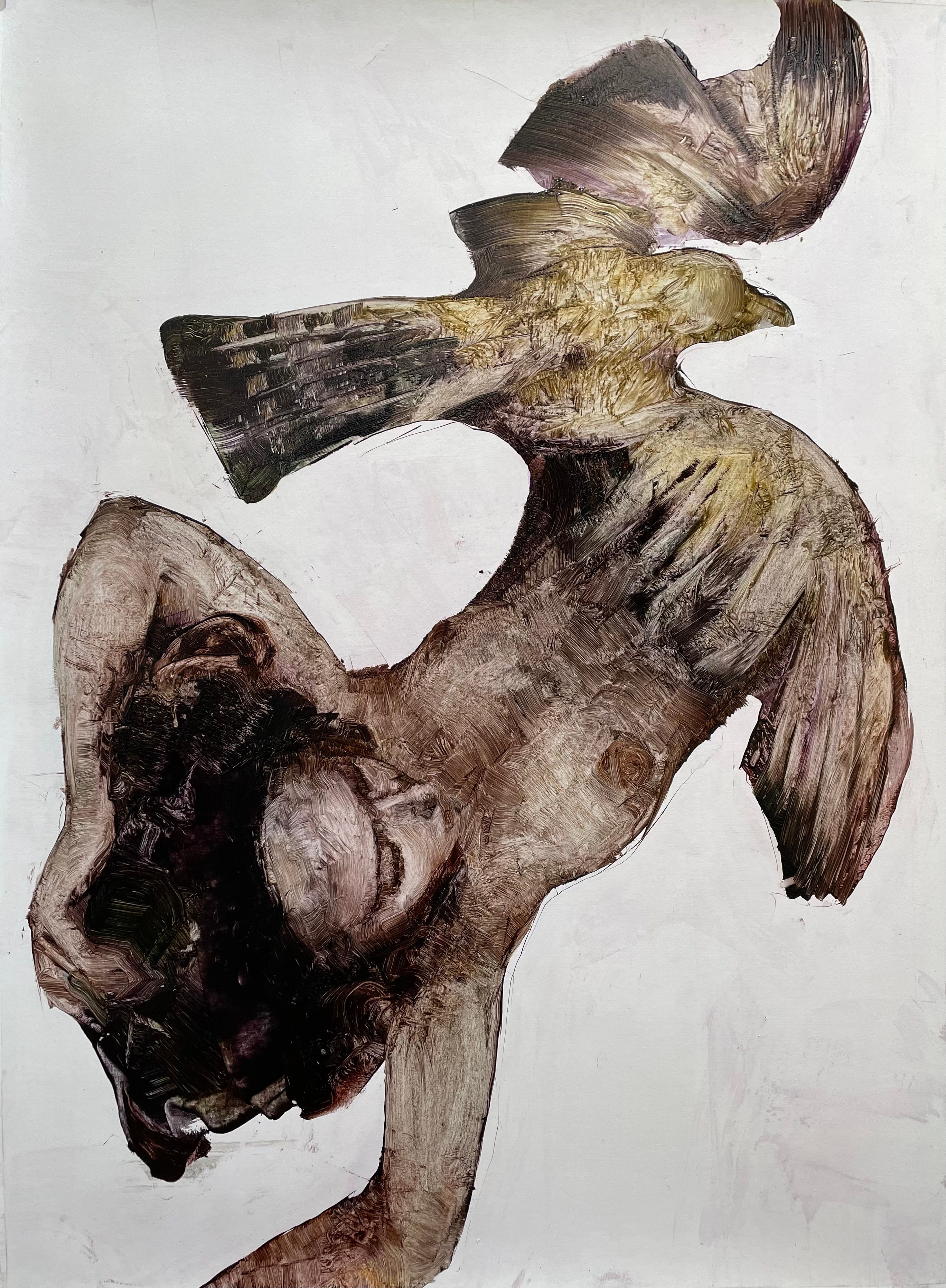
Any interest I currently have in crows does not involve a sense that they’re mentally or physically part of me. If anything, they’re more like neighbors, fellow inhabitants of a particular place, even if they are scavengers and predators. If I perceive in their sharp, eager gazes some kind of intelligence, some kind of insight as well as sight, it interests me in terms of how it allows them to operate in the common spaces we both inhabit. I trust in their being around all the time—unlike the local egrets, who are literally and understandably fair-weather friends.
The day draws near when the egrets will be gone from the local salt marsh, having migrated south for the winter. For now, I enjoy watching them hang out in the trees when they’re not doing their silent, stealthy wading-and-fishing thing.
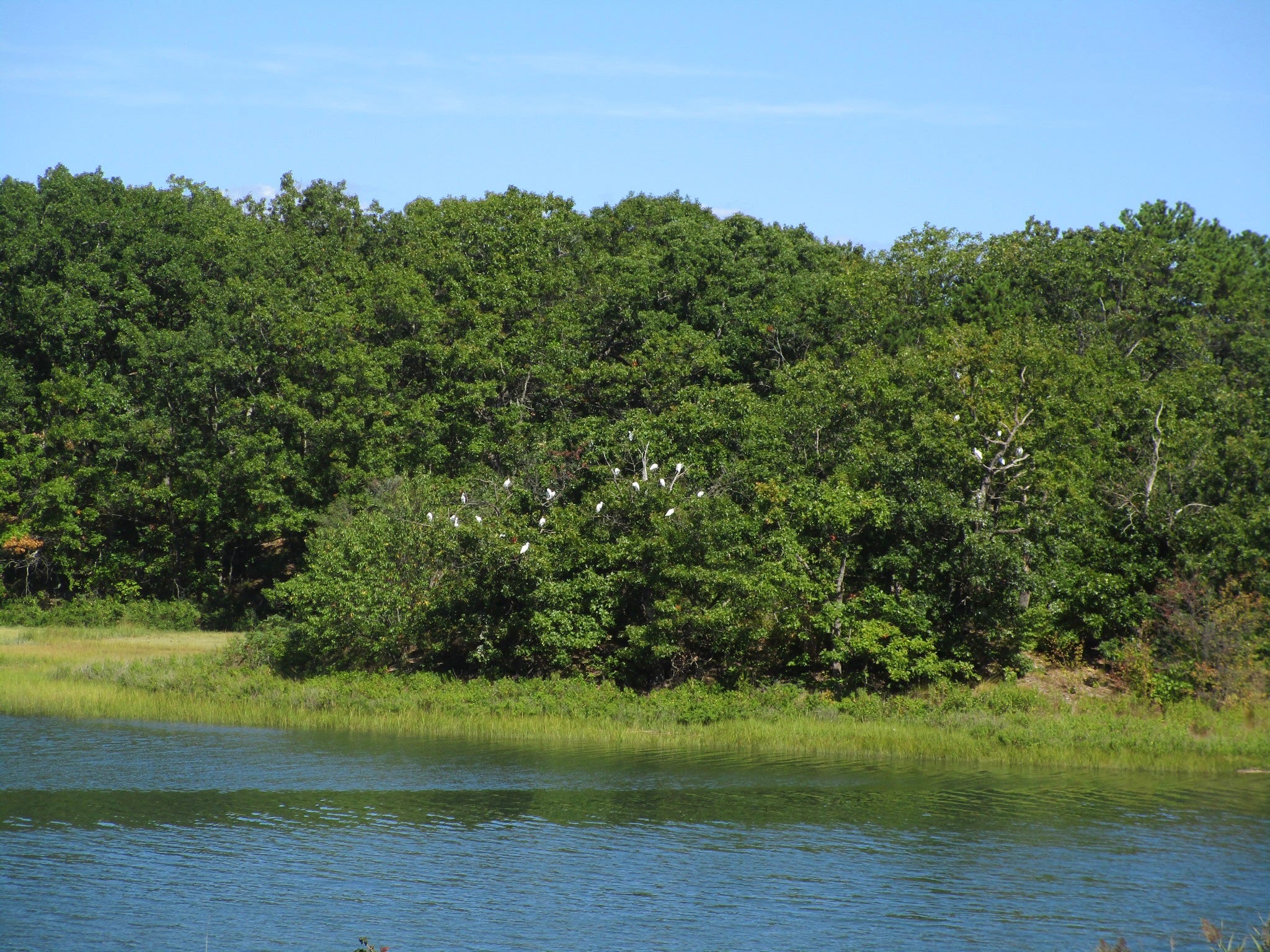
The crows, in contrast, sometimes cluster and sometimes don’t. I have to admit when I see a bunch of them assembled, I wonder what’s up. I don’t think of the egrets as having anything vaguely nefarious up their collective sleeve when they hang together, but there’s something about a gathering of crows that puts me on notice. If such a gathering weren’t called a “murder,” maybe I would feel differently. Maybe I was being premature when I insisted I was uninterested in crows’ ancient reputations.
But never mind my inconsistencies. I write this blog today in appreciation of the trustworthy, non-glamorous, companionable dailiness of my neighborhood crows.
* Redbubble “Dust of Snow by Robert Frost Poster”: https://www.redbubble.com/i/poster/Dust-of-Snow-by-Robert-Frost-by-autumnlinde/29239761.LVTDI
** (Crow poems). (2025, February 2). Crow Poems, 2 by John Clare and three other poets. poetryparc: A selection of old and new poems and reviews, WordPress. https://poetryparc.wordpress.com/2025/02/02/crow-poems/
*** Scott reminded me of the concept of therianthropy, a term that laptop AI says “describes the identification with a non-human animal, where an individual spiritually, psychologically, or physically feels they are part animal.” Scott also told me that, as far as he knows, his paintings are not meant to embody therianthropy, though they merge human and animal forms.
I enjoyed your thoughts on the crows which I don't normally appreciate. I'm more inclined to admire the hawks that live around me. The chirpy squirrels are my ever-present animal neighbors. But what I was most interested in was your puzzling and research about something you'd like to write about but are not sure what the shape of it will be. It reminded me of my current struggles with my quilting efforts.
I particularly appreciate the idea of exploring things or creatures -- in this instance, crows -- as what they are, not what they represent to us representation-fixated humans. Of course, representation creeps in a bit, as do literary resonances, but you bring us back to the crows themselves, alongside whom we live our lives. Since we are still in the Days of Awe, I think I can, with your help, Joan, now bring crows into my field of vision as sources of awe in its most basic sense. Scott's clarifications are helpful as well.